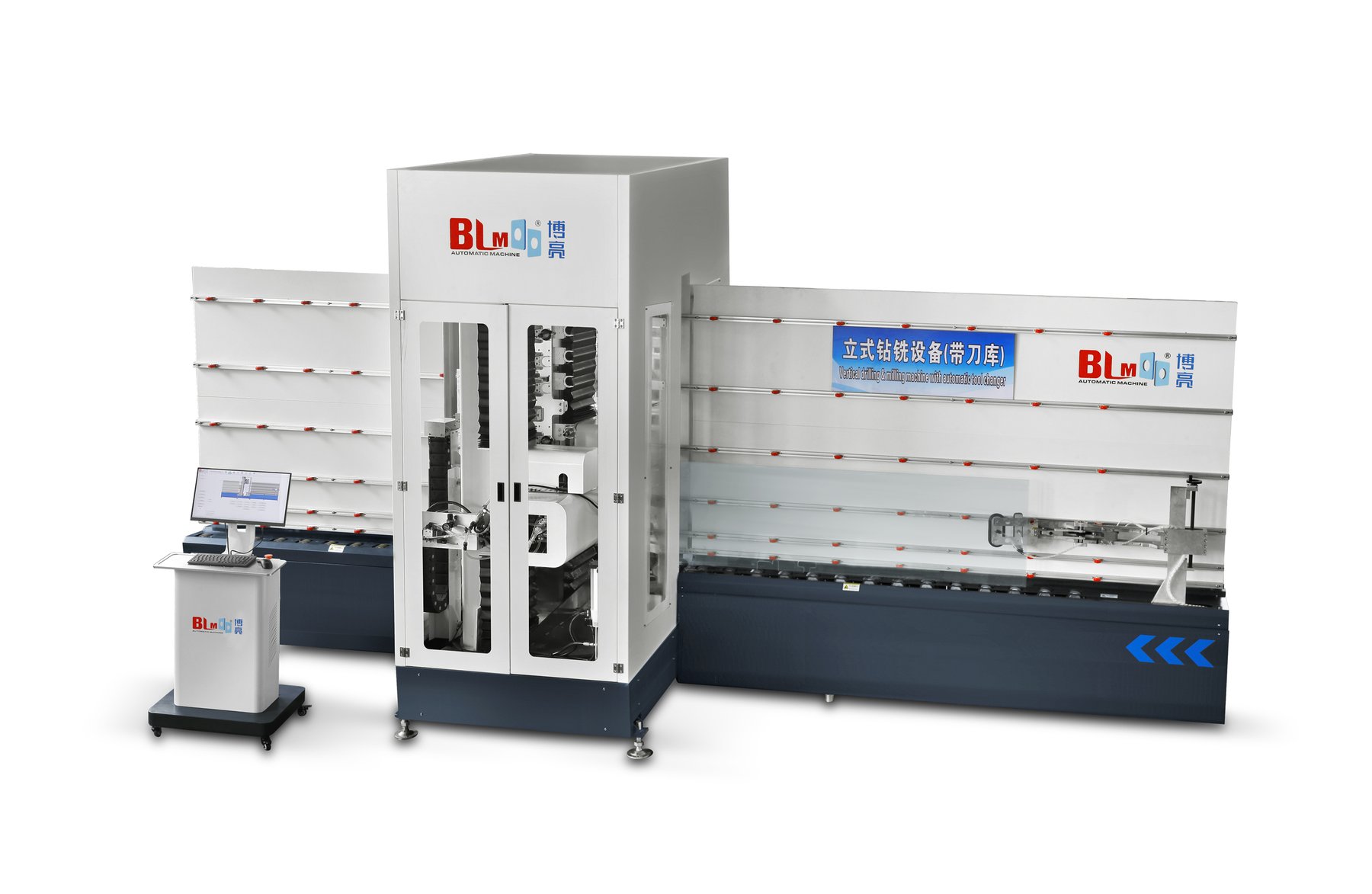
Vertical and horizontal machines differ in how the glass is supported and moved, not simply in speed. If your existing edging and washing equipment already runs panels upright, a vertical machine keeps the panel in one orientation through the whole line. If your work is mixed hole patterns on large sheets and you have a wide, open floor, a horizontal table with a tool magazine is usually easier to stage. The deciding document is a plan view of your panel route — including infeed, outfeed and service access — not a comparison of nominal machine dimensions.
The four questions that actually decide it
A specification sheet will not tell you which orientation fits your factory. These four will:
1. How is the panel supported and transferred? Vertically on an upright conveying line, or flat on a supported table? 2. Where does the machine consume space? Along a narrow line, or across a wide table with clearance on all sides? 3. What equipment sits immediately before and after? Its orientation usually dictates yours. 4. How often does the programme change? Tool magazine capacity and programme import matter more as the mix fragments.
The rest of this guide works through each one with the BLM machines that represent the two routes.
1. Panel handling: upright travel versus supported table
On a vertical drilling and milling centre, the panel travels upright and is referenced against a bottom edge and a vertical datum. This suits large, heavy sheets that are awkward to support flat, and it keeps the panel in the same plane as vertical edging or vertical washing equipment. BLM's A71-series documentation describes an automated conveying system on the upright line.
On a horizontal machine, the panel lies on a broad supported table while the drilling heads move over it. Support across the full sheet is an advantage for wide, thin or heavily loaded panels, and it makes it easier to stage several different jobs around the work area. The trade-off is that the table and its access zone occupy a large rectangle of floor.
Neither route removes handling. The question is whether the panel has to be re-oriented between stations. Every time a panel is tilted from flat to upright or back, you add a transfer, a datum change and a handling risk. That is why the surrounding line usually decides the machine, not the other way round.
2. Floor space: the number on the brochure is not the space you need
The most common layout error is comparing overall machine dimensions and calling the smaller number the cheaper installation. Overall size excludes the infeed and outfeed zones, operator walkways, guarding, tool-service access and the area where finished panels wait for the next station.
| Draft figure | Vertical route — A71X | Horizontal route — A98 |
|---|---|---|
| Maximum glass size | Four variants: 2500 × 1500 / 3000 × 2000 / 4200 × 2500 / 6000 × 3000 mm | 6000 × 2500 mm |
| Glass thickness | 4–19 mm | 4–19 mm |
| Drilling diameter | Φ6–Φ50 mm | Φ6–Φ50 mm |
| Tool holders | 6 × 2 on the 2515 variant; 8 × 2 on 3020 / 4225 / 6030; BT40, 12000 rpm | 8+8 spindles with rotary tool magazine |
| Table height | Project-specific — matched to the vertical line at design stage | 900 ± 20 mm |
| Overall size | Varies by variant (2515–6030); confirmed per quote | 13,700 × 5,600 × 1,800 mm |
Two cautions on this table. First, the A71X exists in four size variants — 2515, 3020, 4225 and 6030 — so "A71X" alone is not a specification. State the variant in any enquiry or layout drawing. Second, the 8300 × 3800 × 1800 mm figure that appears in some BLM drafts belongs to the A71 vertical drilling machine, a different model. It must not be quoted as an A71X footprint.
For the horizontal route, the 13,700 mm overall length is only the machine. A realistic plan view adds an infeed table, an outfeed or transfer zone, a maintenance aisle and a route for the panel to reach washing. In a narrow bay, that is why a vertical line sometimes wins despite a similar nominal footprint.
3. Line hand-off: match the equipment you already own
BLM's A98 line integration case describes an architectural glass line where the drilling equipment was connected to bilateral machines, upper and lower tables and cleaning machines. That is a horizontal-style sequence: the panel stays flat from edging through drilling to washing.
BLM's vertical documentation describes a different hand-off — connecting to vertical edge grinders and vertical washing machines, with online scanning and ERP-based drawing import. The two routes are not interchangeable at the interface. If you already run a vertical edger, a horizontal drilling table forces a turn or a flip; if you run a flat bilateral edger, a vertical drilling centre does the same in reverse.
Before choosing, mark these on your floor plan:
- The direction of panel travel and where the drilling station sits in the sequence
- The elevation of the existing conveyor, edger and washer inlets, compared with the machine table height
- Whether a turn, flip or 90-degree transfer is needed
- Where operators stand, and where finished panels are staged
See the architectural glass solution for the large-format version of this problem, and the line integration guide for the full pre-installation information list.
4. Changeover: what happens when the drawing changes
Mixed orders are where the two routes diverge most. A horizontal multi-spindle machine with a rotary tool magazine can hold a set of drill-bit diameters and select them inside the programme — the A98 draft describes an 8+8 spindle arrangement. That suits a shop running many hole patterns per shift. The vertical A71X draft lists tool holders per variant (6 × 2 or 8 × 2) with BT40 tooling, which supports drilling, milling and polishing in one upright process.
In both cases, ask how a new drawing reaches the controller. BLM drafts mention online drawing import, DXF/CAD files, barcode or QR scanning for automatic hole-pattern assignment, and ERP connection. These are listed as available functions, not as a defined interface specification: the protocol, signal handshake and data format still have to be confirmed against your own factory system for each project.
What to send with a workshop layout
- A dimensioned plan view with the proposed machine position
- Direction of glass travel and the equipment before and after drilling
- Conveyor, edger and washer inlet heights
- Available aisle width, ceiling height and door or loading access
- Maximum panel size, thickness range and typical drawings
- Power and air supply available at the installation point
Not sure which orientation fits your floor?
Send a plan view of the panel route and the equipment already in the line. Our engineers will check the hand-off, clearances and tool-change requirement before proposing a configuration.
Request a Project QuoteWhatsApp insteadA decision sequence you can actually run
1. Draw the current panel route from loading to washing, including every manual move. 2. Mark the constrained movement — the narrowest aisle, the tightest transfer, the heaviest panel. 3. Choose the orientation that removes a re-orientation, not the one with the smaller brochure footprint. 4. Check the largest and smallest panel against the working envelope, including edge distances and minimum panel size. 5. Size the tool magazine against your drawing mix, not against a single sample part. 6. Only then compare quotations, with standard and optional equipment listed separately.
If cost approval is the immediate blocker, continue with How Much Does a CNC Glass Drilling Machine Cost?. If the workpiece definition is still open, start with How to Choose a CNC Glass Drilling Machine for Shower Doors.
FAQ
Does a vertical glass drilling machine always use less floor space?
No. It uses space differently: it concentrates the panel in an upright plane along a line, but still needs infeed, outfeed, guarding and service access. A horizontal table needs a wider rectangle of clear floor. Compare the full panel route, not the overall machine dimensions.
Which is better for large architectural glass?
It depends on the surrounding equipment. Vertical lines suit plants that already edge and wash upright and want to avoid re-orienting heavy panels; horizontal tables suit wide-supported processing with mixed hole patterns. The A71X covers up to 6000 × 3000 mm in its 6030 variant, and the A98 is listed at 6000 × 2500 mm — both documented in the BLM catalogue.
Can a vertical machine connect to my existing washing line?
Only if the interface matches. BLM's vertical drafts refer to vertical edge grinders and vertical washing machines, while the A98 case describes a flat bilateral-edging and washing sequence. Send the conveyor direction and inlet height of your existing equipment; these are project-level checks.
How many tool positions do I need?
Count the distinct hole diameters in a typical shift, plus milling and polishing tools. The A71X catalogue lists 6 × 2 or 8 × 2 tool holders depending on variant. If your mix changes constantly, a rotary tool magazine and programme import (DXF or barcode) reduce manual changeover more than a higher spindle speed does.
Draft figures marked “Pending spec confirmation” come from BLM product documents and are replaced by a signed specification sheet before publication. BLM does not publish unrecorded performance or pricing data.